
Reformer Pilates for Beginners: How to Start Strong at Home
Your reformer is here — this guide covers everything from your first five minutes on the machine to a full 30-day training plan with iFIT, so you start strong from day one.
Jun 25, 2026
·
14 min read

IN THIS ARTICLE
KEY TAKEAWAYS
- Spend a few minutes on your reformer before your first guided session: feel the carriage, test the resistance, and practice changing springs from the home position.
- NordicTrack reformers and iFIT are built as one training system. iFIT provides the instruction, resistance guidance, and structured progression the hardware is designed around.
- New Pilates practitioners should start at two sessions per week. Studio practitioners adding home training should plan for a brief calibration period before stepping back up to their usual level.
- Research on consistent Pilates practice shows meaningful improvements in core strength, flexibility, lower-limb strength, agility, and balance over 8 to 12 weeks of regular training. [2]
- The goal of your first month is fluency with the system, not transformation.
Your reformer is here. This is the moment you’ve been waiting for.
Before you jump into your first class, this guide will make sure you get the absolute most out of your new machine from day one. It covers how to get comfortable on your reformer in the first five minutes, how NordicTrack and iFIT work together to take the guesswork out of every session, what to expect if Pilates is brand new to you, how your home reformer fits alongside your studio practice if you have one, and what a confident, rewarding first month looks like.
Your iFIT library is ready. Your instructors are ready. Let's get you ready, too.
Getting to Know Your Reformer
The most useful thing you can do before your first guided workout is spend five minutes on the machine with nothing playing. No class, no instructor, no timer.
Lie down on the carriage and push it away from the footbar slowly. Feel how far it travels as the cables go slack, and feel the springs pull the carriage back into place. Try varying the force and see how the carriage responds. Then practice adding and releasing resistance while the carriage is fully docked at the home position. The carriage must always be drawn all the way home before you engage or release any spring. Get that habit in early and your sessions will flow without interruption.
Here is a quick guide to the main components and a few things worth knowing before your first class.
The Carriage and Handles
The carriage is the sliding platform you lie, sit, stand, and kneel on. The carriage handles on either side give you grip and stability across a wide range of movements. The rear poggles, at the back of the carriage, give you something to hold during exercises that move the carriage away from the footbar. Getting comfortable with the carriage travel before your first class makes everything click faster once you are in a session.
The Footbar and Positions
The footbar is adjustable. Position 3 has it angled toward the monitor and works for most foundational exercises. Position 4 is vertical, locked upright, and used for jump board work and certain standing movements. Position 1 is the out-of-the-way position: the footbar swivels toward the carriage, giving you a clear line of sight to the platform. Your iFIT instructor will tell you exactly where to set it throughout every class.*
*iFIT Pro membership required to activate this feature.
Spring Resistance and the Push Buttons
Your reformer uses a push-button resistance system. No more manual spring changes. At the push of a button, adjust resistance instantly: green for light (10 kg / 22 lbs), blue for medium (15 kg / 33 lbs), red for heavy (20 kg / 44 lbs). The white spring on Ultra 1 Reform RX and RX-S models is the same weight as red (20 kg / 44 lbs). Mix and match buttons to increase total resistance. Remember the golden rule: carriage at home position before pressing or releasing any button. Your on-screen color-coded spring indicators show your exact resistance in real time, so you always know where you are in your flow.*
*iFIT Pro membership required to activate this feature.
Smart Spine Technology
The NordicTrack Ultra 1 Reformer features Smart Spine technology, the industry-first enclosed spring system. It makes resistance changes smooth and worry-free, and the enclosed spine creates a stable balance beam you can stand on directly, unlocking a wider range of Pilates movements.
Five Quick Safety Tips
Home position first. Slide the carriage all the way to the platform at the front of the reformer. The push buttons only engage when the carriage is fully home.
Check your loops. When not in use, the large loops go over the shoulder pads, not the small ones. Small loops prevent the carriage from closing fully and will shorten the life of your springs.
Step onto the platform first. When getting onto the reformer, always place a foot on the fixed platform first. Never step directly from the floor onto the moving carriage.
Tie your hair back. Before lying down, make sure long hair is secured away from the spine.
Grip socks: optional at home. In a studio we always recommend grip socks for hygiene and safety, but in your own space, bare feet work just fine.
No Guesswork: How NordicTrack and iFIT Work Together
NordicTrack reformers and iFIT function as one integrated training system. The hardware handles spring-based resistance and carriage mechanics; iFIT provides the instruction, progression structure, and real-time feedback that connects your training to a deliberate arc over time. Neither half is complete without the other.
A traditional Pilates reformer is a mechanical apparatus. It does what you ask of it, nothing more. Your NordicTrack reformer is designed differently. When an iFIT instructor cues a resistance change, the on-screen display shows your current setting alongside the instructors in real time. The system knows which reformer you are on and curates content accordingly. Instructor-led programs progress in a deliberate sequence, not a randomized playlist.
And if you notice an iFIT class filmed on a different reformer model, like the Ultra 1 Reform RX or RX-S with different footbar and resistance settings, no problem. The in-workout Reformer Settings on your screen will always show the right settings for your specific machine. No guesswork, no conversions, no interruptions.
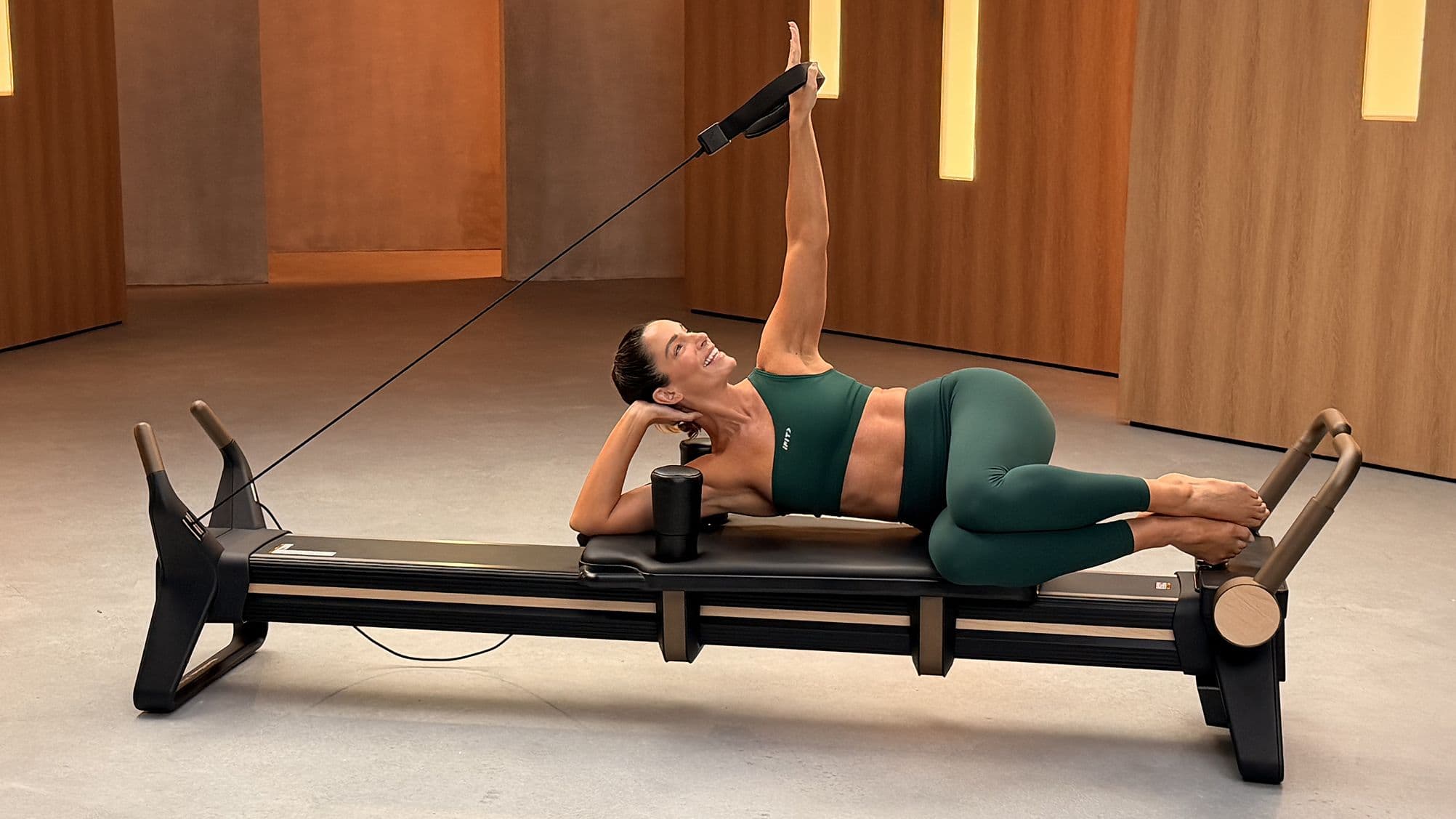
Where to Begin: Your iFIT Starting Point
Reformer Pilates has its own movement vocabulary: footwork, short spine, long box, short box. Learning it without structured guidance tends to produce poor habits that are harder to correct once they are set. iFIT has two resources built specifically for the first weeks of ownership.
How-To Videos with Yvie McGaffin
Three short videos led by Yvie McGaffin, each approximately five minutes. The first walks through the machine itself: carriage mechanics, footbar positions, spring resistance, and safe entry and exit. The second covers machine setup and foundational safety practices. The third focuses on the jumpboard and Pilates box, useful for anyone with those accessories. Watch all three before your first real session and you’ll feel completely at home on the machine.
Strong Foundations Series
Ten beginner workouts led by Jeni DelPozo and Abe Ahern, each 45 minutes. This is where your practice really begins. Build confidence, strength, and control through progressive full-body training as the series teaches you the machine while delivering a genuinely great workout. Sessions cover leg presses, core work, glute activation, dynamic balance challenges, and classic moves like the Hundred and fire hydrant variations. By the final session, you will have trained every major muscle group and covered the full operational vocabulary of the reformer. Start here and do not skip ahead.
Both are searchable directly from the reformer console. If an iFIT instructor references a spring color or resistance label that does not match your machine's system, the on-screen widget translates it automatically. You never need to do the conversion yourself.
The NordicTrack Ultra 1 Reformer gives you access to over 160 reformer-based classes through iFIT, with new content added on a regular release schedule throughout the year.
If You Are New to Pilates
The first two weeks are primarily about learning, not training volume or intensity. You are building familiarity with a movement language that does not transfer directly from other forms of exercise. People who run, lift, or practice yoga still encounter a genuine adjustment period on the reformer, because the machine requires the body to control its position throughout the full range of motion, not just at the endpoints.
Expect some soreness in places that rarely get challenged in other training: the deep abdominals, the hip stabilizers, the muscles along the inside of the shoulder blade. That is a great sign. Those are exactly the muscles a consistent reformer practice develops.
Research supports Pilates as effective for core strength, balance, and mobility. According to Mayo Clinic, Pilates is a good option for those looking to ease low back pain, improve balance, reduce fall risk, and increase mobility. [1] Those adaptations do not come from a single session. They come from consistent, well-guided practice over weeks, which is precisely what working through iFIT's structured programming provides.
Eight weeks of equipment-based Pilates performed twice a week has been shown to produce significant improvements in functional capacity and quality of life in non-active women. [5] Two sessions per week is a sensible starting point for beginners, enough to build movement patterns and allow adequate recovery between sessions. After the first few weeks, adding a third session is a natural step as the body acclimates.
Your Next Series
After completing Strong Foundations, The Resilient Body is a well-matched next step. This eight-session beginner series is led by Ashley Paulson at 40 minutes per session, introducing the jumpboard and Pilates box while alternating cardio bursts with targeted strength work across the core, upper body, and legs. For those who prefer shorter sessions with a progressive structure, Base to Burn with Abe Ahern is worth considering: seven beginner workouts that start at 25 minutes and build incrementally to 60, so the commitment grows alongside your fitness rather than front-loading it.
If You Also Train at a Studio
Your studio practice is a real advantage here. The movement vocabulary, the breathwork, the principle of controlled range of motion: none of that needs to be learned from scratch. What your home reformer adds is something genuinely exciting: the ability to train on your own schedule, at your own pace, with world-class iFIT instruction available any time you want it.
Think of home training as a complement to your studio sessions, not a replacement. Many practitioners find that adding two home sessions per week alongside their studio work accelerates their progress, because the additional repetition deepens the patterns their instructor is working on. Your studio practice and your home practice make each other better.
A couple of things worth knowing as you get started:
Spring naming and color conventions vary between reformer brands and studio systems. A Blue, Red, Green, or White Spring likely mean different weights of resistance depending on the brand your studio uses. Make sure to follow your iFIT instructor and remember: green for light (10 kg / 22 lbs), blue for medium (15 kg / 33 lbs), red for heavy (20 kg / 44 lbs). The white spring on Ultra 1 Reform RX and RX-S models is the same weight as red (20 kg / 44 lbs).
Starting one level below your usual studio resistance for the first few sessions is worthwhile. This is a calibration step, not a step backward. Every reformer has its own feel, and two or three sessions at a slightly reduced intensity is all the time you need to understand how this machine responds. Most practitioners change to full intensity within a week.
For intermediate practitioners, the Signature Series with Yvette McGaffin is a great starting point on iFIT: five sessions of powerhouse work and deep core stabilization through classic Pilates exercises including the wheelbarrow, side lunge, and torso twist, with later sessions adding unilateral challenges and a 60-minute total body finisher.
The NordicTrack Ultra 1 Reform RX-S is built for sustained high-demand training: up to 143 lbs of total resistance, a professional-grade frame, and a longer carriage spine suited to the full range of advanced reformer work.
-Feb_25-159.jpg&w=3840&q=75)
Training Frequency and What to Expect Over Time
The guidance on frequency is consistent across experience levels. Beginners start well at two sessions per week and progress toward three as the body adapts, typically within the first month. Experienced practitioners tend to find three to four sessions per week productive, particularly when session types vary, alternating between strength-focused and mobility-focused work rather than repeating the same approach each time. iFIT's series library is organized by intensity, duration, and training goal to support exactly that kind of variation.
The more significant variable is consistency across weeks. Research on Pilates practice consistently points to meaningful change emerging at the eight to twelve week mark. In one study of previously inactive middle-aged women following a twice-weekly mat Pilates program, significant improvements in core strength, flexibility, lower-limb strength, agility, and balance were observed after 12 weeks. [2] A separate study of trained practitioners performing reformer Pilates at least twice weekly over ten weeks found substantial improvements in core muscle endurance across multiple muscle groups and increased flexibility. [3] An eight-week Pilates program produced significant improvements in flexibility and muscular endurance in adult women. [4]
The pattern is consistent: two sessions per week sustained over weeks produces better results than five sessions for two weeks followed by a gap. Building the habit matters more than building the volume.
Your First 30 Days on a Home Reformer
The goal of the first month is not transformation. It is fluency: the ability to move through a session without stopping to troubleshoot, so that iFIT's instruction can actually reach you. Once that fluency is there, everything else follows.
Weeks 1 and 2
Watch the How-To Videos before your first session. Begin Strong Foundations at a moderate pace, prioritizing quality of movement over effort. Notice which muscles tire first and where your form begins to break down. iFIT's cueing is designed to address exactly those things. Paying attention to that feedback is how the machine teaches you.
Weeks 3 and 4
Continue through Strong Foundations. By the midpoint of the series, the operational language of the reformer, including footbar positions, strap adjustments, and resistance changes, should feel less effortful. The cognitive work of running the machine decreases, and more attention becomes available for movement quality. That is when things start to feel really good.
End of Month One
Strong Foundations still feels challenging? Stay with it and consider adding a third session per week. It feels comfortable? That is the signal to advance within iFIT's programming. The progression path is already mapped out for you. You do not need to plan it yourself.
One thing worth carrying forward: the deepest adaptations from reformer Pilates often become apparent outside of sessions before they become apparent during them. Better posture, more stable core engagement, changed patterns of tension in the lower back. These tend to surface first in daily life. That is the nature of the training. The strength being built is functional, which means it shows up exactly where it is needed.
Explore More
FREQUENTLY ASKED QUESTIONS
References
Karpouzi C, Kypraiou A, Mougios V, Petridou A. Effects of protein supplementation during Pilates training on body composition, core muscle endurance, and joint flexibility in trained women: a randomized controlled trial.
Disclaimer: The primary purpose of this blog post is to inform and entertain. Nothing on the post constitutes or is intended to be a substitute for professional medical advice, prevention, diagnosis, or treatment. Reliance on any information provided on the blog is solely at your own risk. Always seek the advice of your physician or other qualified health provider with any questions you may have regarding a medical condition, and please consult your doctor or other health care provider before making any changes to your diet, sleep methods, daily activity, or fitness routine. Do not disregard professional medical advice or delay seeking it because of information available on this blog. NordicTrack assumes no responsibility for any personal injury or damage sustained by any recommendations, opinions, or advice given in this article. Always follow the safety precautions included in the owner's manual of your fitness equipment.
RECENT ARTICLES

Equipment
Your At-Home Pilates Studio: The Power of Reformer Training with iFIT
A smart reformer tracks your sessions, guides your form, and builds your progress over time. Here is what connected reformer training with iFIT actually delivers.
May 21, 2026 · 8 min read
READ MORE
Fitness
Why Pilates Is More Than Stretching: How It Builds Mobility, Strength, and Control
Discover how Pilates builds mobility, strength, and control through controlled movement and core stabilization.
Jun 4, 2026 · 7 min read
READ MORE
Equipment
Best Pilates Accessories for Home Workouts: Which to Buy First
Prioritize reformer accessories that deliver the biggest training return and lasting studio comfort. Follow a tiered roadmap to decide which attachments to buy first and why.
Jun 9, 2026 · 8 min read
READ MORE